Cardio Equipment Names: A Commercial Gym Buyer's Glossary
Cardio equipment names explained: motorised and curved treadmills, cross trainers, upright and recumbent bikes, stair climbers and rowers in commercial gyms.
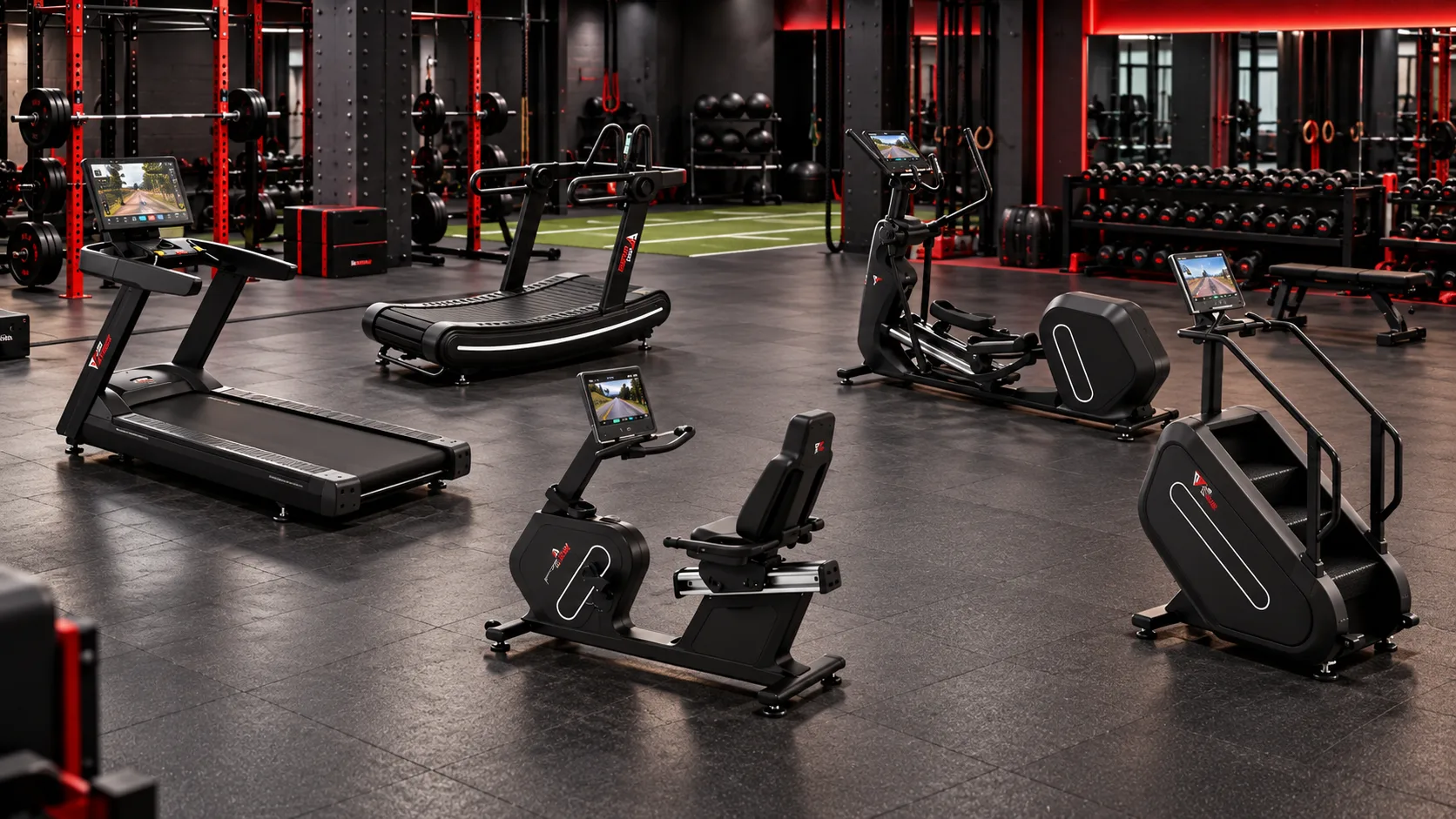
"Treadmill" and "bike" cover maybe half of what's actually on a commercial gym floor. Curved treadmills, recumbent bikes, step mills and air rowers all do different jobs for different members, and the names get used loosely even in trade conversations. This glossary walks through the real cardio equipment categories a commercial gym stocks, what each one is actually for, and — honestly — where Gym Factory's own cardio range sits inside that wider picture.
Treadmills: motorised, curved, and manual
A motorised treadmill uses an electric motor to drive the belt at a set speed and incline, with a console for programmes, heart-rate tracking and connectivity — this is the format most members picture and the one commercial gyms buy in volume. A curved treadmill replaces the motor with a concave, non-motorised belt that the runner's own stride drives directly, which makes speed self-limiting and is popular for sprint intervals and functional conditioning classes. A manual (flat) treadmill is the same self-powered idea on a flat belt — cheaper to build, more common in home and budget settings than on a commercial floor. Gym Factory's confirmed lineup covers the two commercial-relevant formats: the CA1 Commercial Treadmill (motorised, for €3,885 ex-VAT) and the CA2 Curved Treadmill (for €3,675 ex-VAT), described as suited to sprint and functional cardio training.
Elliptical (cross) trainers
An elliptical trainer — called a "cross trainer" in a lot of UK gyms — moves the feet through an elliptical path rather than a straight line, so there's no foot-strike impact through the joints. Many models add moving handlebars so the arms work at the same time, making it a full-body option rather than a lower-body-only machine. It's typically the go-to recommendation for members returning from injury or anyone who wants a hard cardio session without the pounding of running. Gym Factory's CA3 Elliptical Trainer (for €3,360 ex-VAT) is positioned this way — as the joint-friendly option in its cardio range.
Exercise bikes: upright vs recumbent
An upright bike puts the rider in a standard cycling posture, pedalling beneath the body, which engages the core more and is the format used in group-cycling studios. A recumbent bike reclines the rider into a seat with back support and pedals out in front, lowering the impact on the lower back and hips — it's a common choice for older members, rehab clients, or anyone who wants a longer, lower-intensity session. Here's the outcome: Gym Factory's confirmed catalogue includes the reclined format — the CA4 Recumbent Bike (for €2,940 ex-VAT) — with no upright or indoor-cycling bike confirmed in their range as of this research. A gym building out a full cycling studio would need to source that separately.
Stair climbers and step mills
A stair climber replicates the motion of climbing stairs, either through independently moving pedals or a continuously rotating "step mill" staircase, and is one of the higher-intensity lower-body cardio options on a typical floor. It's a compact footprint for the workout it delivers, which is part of why it shows up even in space-constrained clubs. Gym Factory's CA5 Stair Climber (for €3,780 ex-VAT) is described as intensive lower-body cardio, consistent with how the category is generally used.
Rowing machines and the rest of the cardio family
Beyond the four categories above, a commercial floor commonly carries several machine types that are worth defining even though they're not part of Gym Factory's confirmed range. A rowing machine simulates the rowing stroke against air, water, or magnetic resistance and works legs, back and arms in one continuous movement. A ski ergometer mimics the double-pole motion of cross-country skiing, standing and pulling two handles downward. An assault bike (sometimes called an air bike) combines pedalling with moving handlebars against fan resistance and is a staple of high-intensity interval formats. An arc trainer is a variant on the elliptical that uses a different, more adjustable stride path. These items are not currently listed within Gym Factory's verified 13-category shop, so any cardio zone requirements involving them would be best discussed separately to identify the most suitable sourcing options alongside the Gym Factory equipment range.
Where Gym Factory's cardio range actually fits
Gym Factory has more than 180 confirmed machines across strength, functional and multi-station equipment, built in Lithuania with ISO-certified production and the same tiered warranty structure across the range (30 years on frame and structural elements, 36 months on mechanical moving parts, 12 months on cables and belts, 6 months on upholstery). Gym Factory currently offers a focused cardio range built around five key machines: treadmill, curved treadmill, elliptical, recumbent bike, and stair climber. Rather than trying to cover every possible cardio format, the range concentrates on core commercial cardio equipment that complements Gym Factory's broader strength and functional training catalogue.
For many gyms, this allows the main cardio stations to be sourced alongside the rest of the Gym Factory equipment package, creating a more consistent purchasing and equipment-planning process. If a project requires additional specialised cardio formats beyond the current Gym Factory range, those requirements can simply be considered separately as part of the wider equipment plan.
All prices shown above are Gym Factory's EUR, ex-VAT manufacturer prices. Final pricing for the UK, Canada, and the US may vary where applicable due to currency conversion, local taxes, duties, and delivery costs.