How Much Does Commercial Gym Equipment Cost?
How much commercial gym equipment costs and why: build tier, machine type, new vs used, ordering terms and the extra costs to budget for beyond the machine.
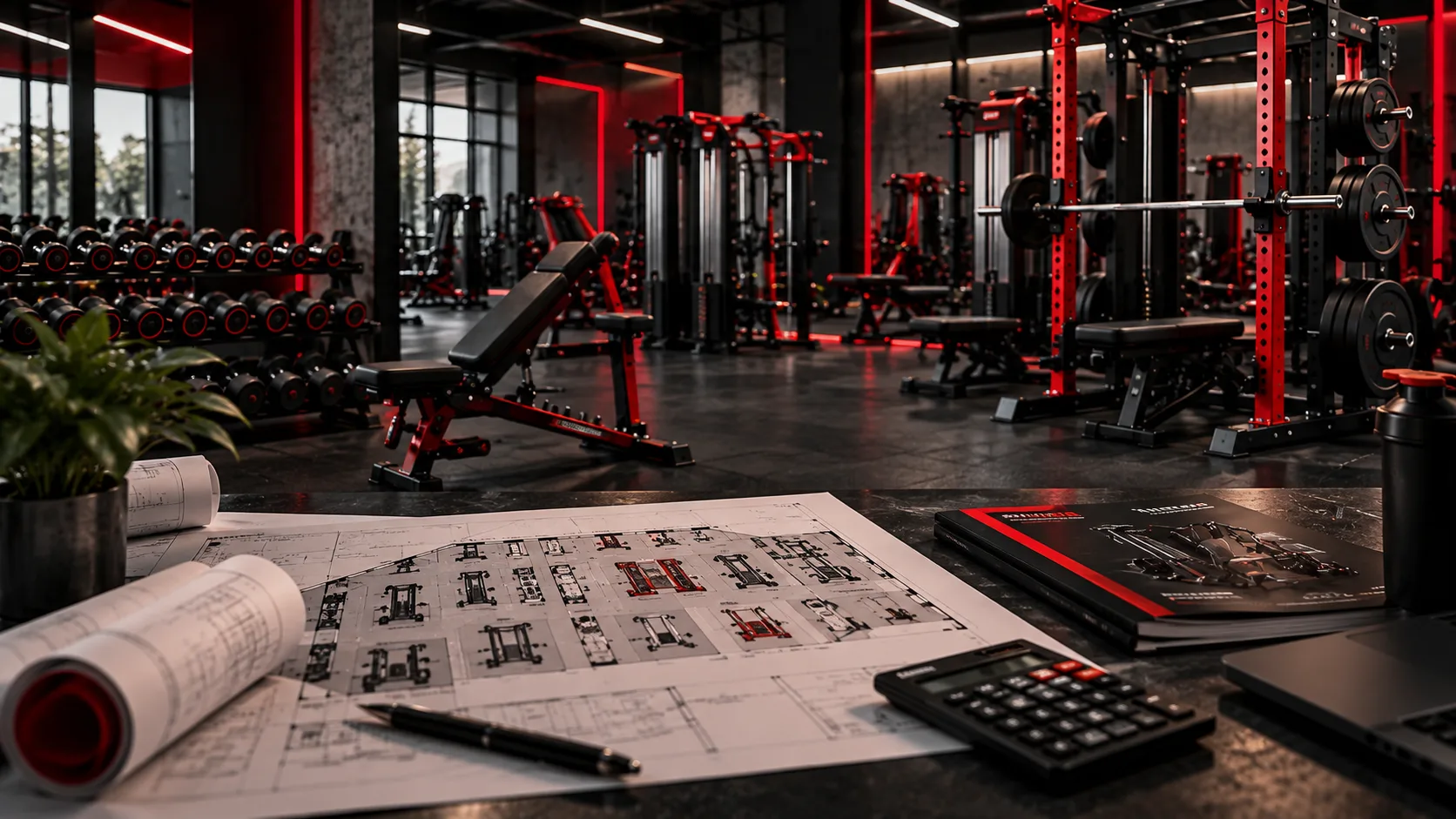
There's no single number, and any guide that gives you one flat figure is guessing. Commercial gym equipment prices swing enormously by machine type, build tier, customization, and how many units you're ordering at once — the honest answer is a set of factors, not a price tag. Below is what actually drives cost, how Gym Factory's manufacturer-direct pricing model works for Gym Factory customers, and what else belongs in your budget beyond the equipment itself.
What determines the price of a commercial gym machine?
Four things move the number most: build tier (light-commercial equipment built for lower daily use costs less than full-commercial equipment engineered for all-day, multi-user gym traffic), mechanical complexity (a single-station selectorized machine is simpler and cheaper to build than an 8-in-1 multistation rig with several independent weight stacks), customization (bespoke dimensions, handle position, or colour add cost and production time versus a standard configuration), and order size. Fitting out an entire gym floor versus buying one machine changes the economics too — freight, paperwork, and a single production slot get spread across more equipment rather than repeated for each individual order, which is one reason why full fit-out quotes and single-machine quotes rarely scale in a simple straight line.
Why is commercial-grade equipment so much more expensive than home gym gear?
Because it's built for a different job. Home gym equipment is engineered for occasional, single-user use. Commercial equipment has to survive dozens of different bodies a day, every day, for years — which means heavier-gauge steel frames, industrial bearings and pulleys, larger weight stacks, and upholstery rated for constant turnover rather than home traffic. That extra material and engineering is the price difference. It's also why a genuine manufacturer warranty matters more on commercial-use equipment than on anything built for a Home gym.
Does the type of equipment change the price? (push, pull, legs, cardio)
Yes, noticeably. Using Gym Factory's own EUR ex-VAT manufacturer prices as illustrative examples only:
- Push machines (chest, shoulders, triceps) tend to sit in the middle of the range — a chest press machine like the A1XX runs €1,229–€1,481 ex-VAT.
- Pull machines with more cable runs and pulleys trend higher — a cable crossover station like the C2XX spans €1,344–€1,995 depending on configuration.
- Leg machines are usually the heaviest and priciest strength category because of the reinforced frame and bigger weight stack a leg press needs to handle — a leg press machine like the D3X can reach €3,796.
- Cardio machines sit in a comparatively narrow band because motors and electronics, not steel tonnage, are the bigger cost driver — a commercial treadmill like the CA1 runs at €3,885 ex-VAT.
Multi-station rigs that combine several different machines into one frame— Gym Factory's 8-in-1 M7X, for example, lists at €11,387–€15,167 ex-VAT — cost more per unit but can replace several standalone machines and their individual use cases.
How much cheaper is used equipment — and what's the catch?
Used commercial equipment is typically sold at a meaningful discount to new, which is the entire appeal. The catch is that you lose the manufacturer warranty and inherit unknown wear on exactly the parts that fail first under commercial use — cables, belts, upholstery, and mechanical moving parts like bearings and pulleys, which is precisely why manufacturers like Gym Factory warranty those components on a shorter tier (12–36 months) than the structural frame (30 years). A used machine gives you no visibility into how much of that shorter-life clock has already run. See our full breakdown in New vs used commercial gym equipment for how to weigh that trade-off machine by machine.
How does Gym Factory's manufacturer-direct pricing and ordering process work?
As Gym Factory's official distributor for the UK, Canada, and Northern US, Sports Lodge works from the manufacturer's real ordering process: you get a written quote within 48 hours of submitting a complete equipment list, a 50% deposit confirms the order and puts it into the production queue, and the remaining balance is due after production is complete but before the equipment ships. Production typically takes 6–8 weeks, with delivery adding roughly 1–2 weeks within the EU (longer outside it, which is the relevant case for Canada/US orders). Bespoke specifications — dimensions, handle position, colour — are available but should be requested at quote stage since they affect both price and production time.
Are those EUR prices the same as UK, Canada, or US retail pricing?
The underlying Gym Factory machine price does not change simply because the equipment is being purchased for the UK, Canada, or the US. The figures above are Gym Factory's EUR, ex-VAT manufacturer prices as listed on gymfactory.eu.
What can change, where applicable, is the final landed price. Depending on the destination, this may include currency conversion, import duties and taxes outside the EU, UK VAT or applicable Canadian/US sales tax, and delivery costs.
So the manufacturer-side EUR price remains the same reference point, while the final amount payable in your market may vary depending on those additional costs. For an accurate, current landed price, request a quote from the Gym Factory distributor responsible for your region.
What other costs should I budget for besides the equipment price?
Beyond the machine cost itself, build a realistic budget around: shipping and logistics (production is 6–8 weeks with 1–2 weeks EU delivery on top, and transit runs longer outside the EU); import duties, VAT, or local sales tax depending on where you're importing to; installation (confirm at quote stage what's included versus arranged separately — equipment ships disassembled with screws pre-installed to simplify setup, though some models are fully welded); and financing. Buying outright with a 50% deposit isn't the only route — leasing and equipment finance are common ways commercial gyms spread the cost, covered in more depth in Equipment finance and Leasing vs buying commercial gym equipment.